

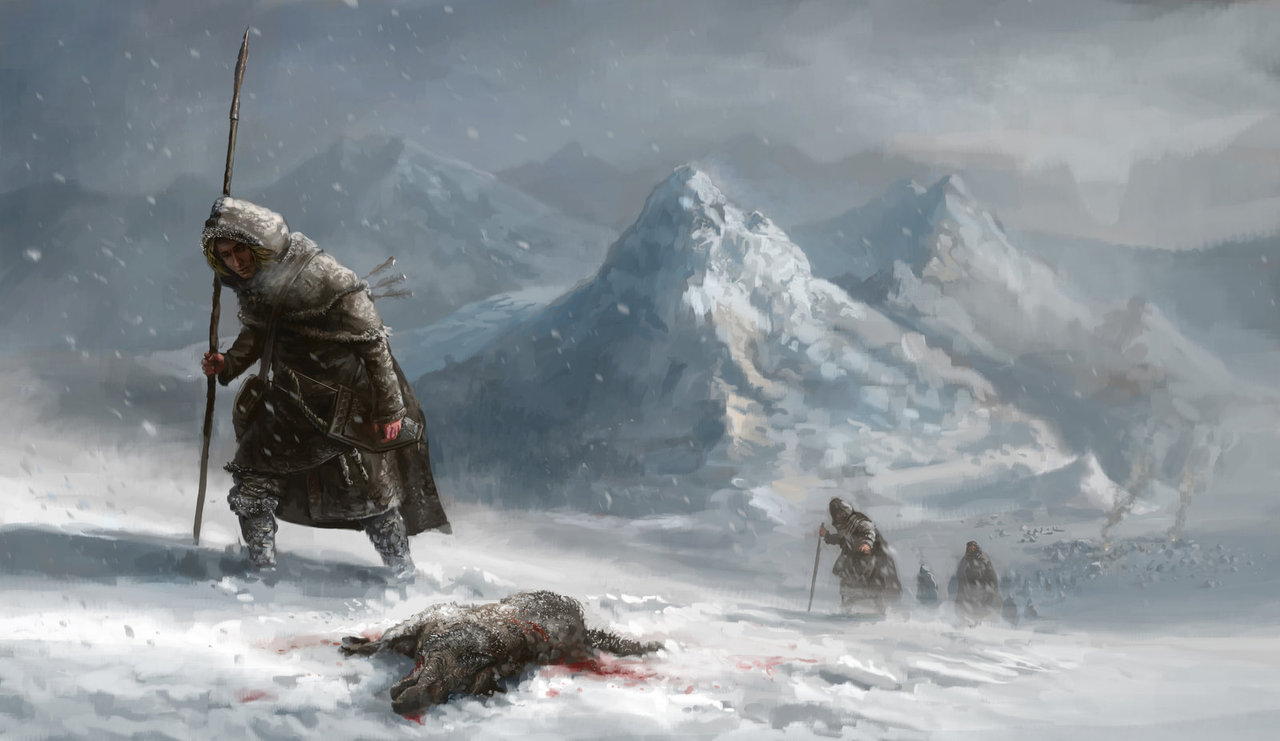
Ancient Vikings of Scandinavia and Scythian-Kyrgyz-Huns: What Do They Have in Common?
American DNA researcher David Faux has put forward a sensational hypothesis regarding the possible cultural and genetic connection between the Vikings and the Kyrgyz-Wusuns (Azes), Scytho-Huns, as well as a link between the Scandinavian royal dynasty of the Ynglings and the ancient Scythian tribe of the Dingling, who are considered ancestors of both the Kyrgyz and Uighurs.
His hypothesis is based on the analysis of Y-chromosome data, along with archaeological, historical, and linguistic evidence.
An excerpt from this research:
The R1a, Y Chromosomes of Scandinavia and the Norse Colonies
“There are some clues that suggest that there is something different about a subset of R1a, Y chromosomes from Iceland to Sweden.
First, the process of administering the Shetland Islands Y-DNA Surname Project meant that the author was provided with the series of matches for each R1a individual via the Haplogroup Database of Family Tree DNA.
Here a 12 marker haplotype is compared to a world – wide SNP tested database accumulated by Michael Hammer and his team of the University of Arizona. Some individuals have most of their close matches in Poland, India, and a variety of locations between.
However there is another set of R1a participants who match more individuals in China, Mongolia, and Central Asia – particularly the Altai. For example the R1a Shetlanders with aboriginal surnames (patronymic usage genealogically proven) have only a scattering of matches anywhere in Europe, but considerably more located well east of Scandinavia. As an example, the two R1a Williamsons have 19 matches at the 10/12 level with the Altai, and another 14 at the 9 of 12 level.
It is clear that the Shetland example most closely matches the Central Asian Altai, Kyrghyz, and Tajiks (all from Kazakhstan or other areas along the Chinese border with Siberia), plus the Azeri who reside on the west side of the Caspian Sea.
As to Scandinavia, the two areas with the closest matches are Northern Norway, and in Sweden Uppsala and Varmland; as well as the Norse colony of Iceland. The differences seen in relation to Northern Poland are perhaps most striking.
There is one more piece of the genetic puzzle that can add significant information on the origins of the Scandinavian R1a Y Chromosomes, and it relates to one marker which appears to clearly differentiate some Norwegian haplotypes from all those found in Eastern Europe.
A Unique Genetic R1a Polymorphism Separating Norwegians from Eastern Europeans.
One potentially important observation here is that among the groups to most closely match the Shetland participants are the Kyrgyz (Kirghizes), who are called Ases (with As being common as a Turkic ethnic or geographical name), the term given by Icelandic Sagas to the ancestors of the Scandinavian Royalty.
(Kyrg. Amer. Found.: Tabyldy Akerov:
“N. Aristov, V. Barthold, L. Gumilev, and others considered the Wusuns and Kyrgyz as descendants of the Dingling. At the same time, L. N. Gumilev viewed the Xiongnu (Huns) as a mixture of their Mongoloid ancestors and the Europoid Dingling. In his opinion, the Yenisei Kyrgyz could have emerged not only from the mixing of the Gyangun with the Dingling but also with the Huns [301. –P. 63].
N.A. Aristov linked the Wusuns with the ancient Kyrgyz. In his opinion, the Wusuns were part of the Yenisei Kyrgyz, who, by the 2nd century BCE, separated from the main group and migrated to the Tian Shan region.
Here, they became the ancestors of the Tian Shan Kyrgyz. N.A. Aristov viewed the Azik tribe as the formative ethnic group of the ancient Kyrgyz [26. –Pp. 218-219]. A. Bernshtam supported the identification of the Asii with the Wusuns. He wrote that the ethnonyms “Asii,” “Wusun,” and “Kushan” were Tocharian renditions of the name “Wusun,” justifying the information about the “Asii—kings of the Tocharians…”
He believed that “the Issedones were tribes from the eastern part of Central Asia, neighboring southern Siberian tribes, and have been known to ancient science since the 6th century BCE, when the Saka left the Tian Shan for Central Asia and the Amur region, with part of the Issedon tribes—Asii and Pasiani—going with them.” He also considered that “Wusun” was a shortened form of the ethnonym “Issedon.”
In a similar situation were the ethnonyms “Asii” and “Pasiani,” represented here in different phonetic forms. It is evident that this refers to different variants of the same ethnonym, with the root sounding as as/is/us/ in various texts [62. –P. 99.].
Thus, A. Bernshtam attempted to view the Wusuns and Az as one ethnic group. It should be noted that the Az have always been associated with the Kyrgyz in scholarly literature.
Most scholars recognize the significant role of the Az in the process of consolidating the Yenisei Kyrgyz. The belief that the Az were the aristocratic clan of the Yenisei Kyrgyz has long been established in academic circles.
Academician V. Barthold wrote that in the runic inscriptions, the people of Az are mentioned several times alongside the Kyrgyz. In the book Badayi at-Tawarikh (17th century), the Kyrgyz were called Az [3.-P. 426. Note 78.].
It should be noted that most scholars, such as S. Malov, G. Grumm-Grzhimaylo, S. Kisilev, N. Serdobov, D. Savinov, Yu. Khudyakov, and V. Butanaev, suggested that the people referred to as “Ach” or “Az” in runic texts were Kyrgyz.
S. Kisilev and N. Serdobov placed the Kyrgyz clan “Ach” (Az) in the middle reaches of the Ius River and the Uybat River in the Minusinsk Basin. According to D. G. Savinov, in the 7th-9th centuries, the people “Ach” (Az) formed the core of the Kyrgyz ethnicity.
In the opinion of V. Butanaev and Yu. Khudyakov, the people “Az” or “Ach” should be identified with the ruling family of the Kyrgyz state, which is recorded in Chinese chronicles in the form of “Ajo” (Ajie).
V. Butanaev and Yury Khudyakov wrote that, “based on the context of the monument dedicated to Kül Tegin, it can be assumed that the ‘Az’ represented the elite part of the Kyrgyz…” [345. –Pp. 77-78; 89.-P. 72.].
However, it should be noted that N. A. Aristov justifiably saw the Asigi as descendants of the Wusuns. That is, we support the opinion of scholars that the Az lived in the Tianshan region since the time of the Wusuns.
The Wusun (or Az), like the Yuezhi, were an elite clan in Dingling society. It is possible that this elite status motivated the Xiongnu leader to take in the newborn prince, who was under the protection of Tengri (the sky), to love and raise him—thus forming an alliance with the Wusun.
In this way, the Xiongnu aimed to finally eliminate the more powerful Yuezhi, who posed a constant threat and disrupted their peace. However, in order to get rid of their enemies and boost the morale of their warriors, the Xiongnu leader needed a strong ally, a powerful and spirited tribe with the support of Tengri. This tribe turned out to be the Wusun, whose totem was the wolf.
Another reason for the creation of the Wusun-Xiongnu alliance could have been the fact that the Yuezhi and Wusun were related tribes, both governed by representatives of the same aristocratic clan, whose totem was also the wolf.
Therefore, from the above, it can be concluded that the Wusun, as one of the branches of the Dingling, may have been their aristocratic clan.
It is evident that the connection between the Wusun and the Xiongnu not only points to the kinship of these two groups and the influence of the former (the Dingling) on the latter but also suggests that the Xiongnu were gradually absorbed by the Dingling-like Wusun and their eastern branch, the Kyrgyz (Az).
The alliance between the Wusun and the Xiongnu demonstrated the influence of the Dingling on the Xiongnu, which ultimately led to the absorption of the western Xiongnu by the Dingling-like Kyrgyz (Az).” - Tabyldy Akerov, Candidate of Historical Sciences, Director of the Institute of Ethnology at the International University of Kyrgyzstan.)
For thousands of years the peoples of the Altai who were largely of haplotype R1a lineage with smaller numbers of Q and K, and continued to live the nomadic lifestyle of their ancestors.
In the years preceding the birth of Christ there appear to have been pressures exerted by the Chinese peoples who lived nearby, and perhaps also due to an explosion in population, some of these Scythian peoples began to move in successive waves to the west toward the Caspian Sea.
Based on the haplotype examination above, and recognizing that population structure may have changed over time, the tribal groups and geographic regions that appear to have made the most significant contribution to this migration include the Altai of the Altai Mountains of Siberia near the Mongolian border, and the people who today are known as the Khirgyz and Tajiks from Khirgystan and Tajikistan.
They followed the old “Silk Road” to beyond the Aral Sea and the Caspian Sea to the Don River and the Azov Sea. Here they came directly into contact with the descendants of a Swedish people known as the Ostrogoths (there still being a city of this name in Sweden today).
These latter people had begun their long march south (as reflected in the series of dated archaeological sites), and by the 4th Century AD had absorbed the local Scythian peoples, the Alans or Ases people across the top of the Black Sea west to the Danube River.
Into this mélange in the year 376 came the Scythian Huns who in turn drove off the western branches of the Ostrogoths and other Germanic peoples, and subjugated the proximal Ostrogoths. Here they co-existed and according to some sources the Scythian peoples came to use German as the lingua franca of the day.
Here a leader known as Uldin (Odin in Norse) emerges and makes a name for himself in the Roman world before disappearing from the world’s stage (i.e., from the awareness of the classical writers) in 408.
The Icelandic Sagas report that the Asir people resided across the River Don, with their principal settlement being a city wedged along the Caucasus Mountains, and it is here that Odin’s two brothers stayed with some of their people as Odin began his northward migration.
Thus we should expect to find some group of people in the area who conform to the descriptions of Snorri. The Azeri people (Azer being as close to Aesir as one can imagine) are today a group residing in the mountains of Azerbaijan. Clearly they have intermixed with the local Middle Eastern population as reflected in the predominance of the haplogroup J signature in the Azeris.
However there is a contingent still present in this population, dissimilar to their neighbors, who in fact carry the three Asian signatures seen in Shetland (a Norse colony), and the signatures are more similar between these two northern and southern regions than any other group between Turkey and Mongolia.
It is likely that the R1a, K and the Q identified in this study are from Central Asia – the home of the Aseri R1a signature, which is modal to those detected in Central Asian Altai populations.
In the epoch known as the “Migration Period”, there were waves of documented and undocumented mass movements of people across vast expanses of Europe such that Germanic peoples were found in Italy, Spain and North Africa by the middle of the 5th Century.
It is proposed that, as is reported in the Norse Sagas written down by Snorri Sturluson, Uldin and the composite Sarmatian / Hunnish – Germanic people that accompanied him moved north to the homeland of the Ostrogoths, negotiated with Gilfyr the then king of the Sveres (probably making him an offer of power sharing that Gilfyr could not refuse – considering the Hun reputation for the use of extreme violence to get their way) for lands around Lake Malar at Gamla Uppsala to settle the majority of his people.
He did, however, send his sons to occupy other lands, including Oslofjord in Norway.
This perspective on history is supported by the archaeological record where at Gamla Uppsala there are three burial mounds attributed to the kings of Sweden in the 5th Century, and the burial practices are consistent with those of the Scythian peoples (cremation burials with a wealth of grave goods with a twenty foot mound over top). Similar burials are seen all the way back to before the birth of Christ in the Altai.
Furthermore, in looking at the R1a genetic signatures of 4 locations in Norway and 5 in Sweden, it is clear that the people who most resemble the Y chromosome DNA signatures in the Altai are found at Gamla Uppsala and Vasterbotten in Sweden, and also in Northern Norway.
Furthermore in the Norse colonies of Shetland and Iceland the R1a signatures of about 30% of those with this haplogroup are similar to those of Northern Norway as well as in Southern Norway which historically are the areas considered to have been the source population for those who emigrated to Shetland and Iceland during Viking times.
While the emphasis here has been on the R1a, Y chromosomes, it is the Q that is (other than a sprinkling along migration paths) seldom found west of Central Asia. It is this signature that speaks loudest as to the immigration of Asians to Scandinavia. It is not found anywhere between Russia and Spain at even 1%, although is found at low levels further south in Turkey and Hungary – both areas which in historical times have been “exposed” to Hunnish peoples.
Q is found in Norway and her colonies (including Britain – but at very low levels). A reasonable estimate of Q in Norway would be 4% - but very scattered and would only manifest itself in large samples or in regions where through the founder effect or genetic drift more Q is concentrated.
This figure also applies to Iceland and Shetland. The K from the Asia turns up very occasionally in Swedish and Norwegian samples, and has been documented in the Faroe Islands (a Norse colony) and Shetland.
Clearly it seems probable by an examination of the distribution of Y chromosomes today that the majority of the Asian group was R1a, followed by Q, then K. The best estimate of the total percentage of Asian Y chromosomes in the Norse population is 4% Q plus 1% K plus 10% via R1a making a total of 15%. The reason why the timing of the influx of people can be dated to before 793 is that Q is also found in the colonies founded by Norway during early Viking times.
The human genetic data is even supported by a comparison of the genetics of the Norwegian Fjord horse and the Mongolian horse and the data suggests that the migrants to Scandinavia brought with them their prized horses which became the root stock of the Norwegian equines of today.” - Dr. David K. Faux
Source: The Genetic Link of the Viking – Era Norse to Central Asia: An Assessment of the Y Chromosome DNA, Archaeological, Historical and Linguistic Evidence - Dr. David K. Faux
Read full article: https://www.kyrgyzamericanfoundation.org/post/kyrgyzvikings
 |
|---|
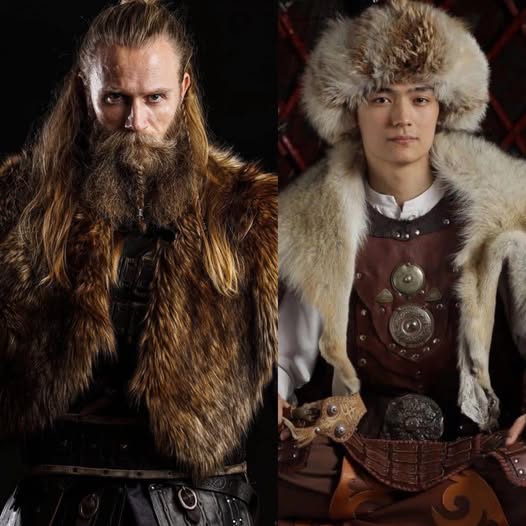
Vikings and Scythian-Kyrgyz-Huns Connection
Core Argument
DNA researcher David Faux proposes a genetic and cultural connection between Scandinavian Vikings and Central Asian Kyrgyz-Wusun, Scythian-Huns, suggesting the Scandinavian Yngling dynasty may descend from the ancient Scythian Dingling tribe.
Key DNA Evidence (R1a Y-Chromosome Analysis)
1. Shetland Islands R1a Analysis
- Some R1a matches Poland/India
- Another R1a group strongly matches China, Mongolia, Central Asia (especially Altai)
- Shetland natives with aboriginal surnames: 19 matches with Altai at 10/12 level
2. Closest Matching Regions
- Central Asia: Altai, Kyrgyz, Tajiks, Azerbaijani (Azeri)
- Scandinavia: Northern Norway, Uppsala Sweden, Iceland
- Significant differences from Eastern Europe (Poland)
Historical Connection: Ases/Azes = Kyrgyz
“Ases” in Icelandic Sagas
- Mentioned as ancestors of Scandinavian royalty
- “Ases” or “Az” is another name for Kyrgyz
- Ancient records identify Kyrgyz and Az as the same people
Relationship between Wusun and Az
- Wusun = Az = Aristocratic clan of Dingling
- Allied with Xiongnu, worshipped wolf totem
- Developed into Yenisei Kyrgyz from Tian Shan region (2nd century B.C.)
Migration Route (4th Century A.D.)
Central Asia → Europe
- Scythian nomads from Altai Mountains (primarily R1a haplogroup)
- Moved westward along Silk Road
- Caspian Sea → Don River → Sea of Azov
- 376 A.D. Huns arrived - Interacted with Ostrogoths
- Moved north under leadership of Uldin (Odin?)
Settlement in Sweden (5th Century)
- Settled around Gamla Uppsala
- Archaeological evidence: Scythian-style cremation burials (20-foot mounds)
- Also settled in Oslofjord, Norway
Genetic Evidence Summary
Asian Y-Chromosome Percentages in Scandinavia
- R1a (Asian lineage): 10%
- Q (Unique to Mongolia/Central Asia): 4%
- K: 1%
- Total approximately 15% of Central Asian origin
Characteristics
- Q haplogroup rarely found between Russia-Spain
- Found only in Norway, Iceland, Shetland
- Genetic similarity between Norwegian Fjord horses and Mongolian horses
Conclusion
Before the Viking Age (793 A.D.), Scythian-Hun groups from Central Asia (Altai, Kyrgyz) had already settled in Scandinavia and became the foundation of Scandinavian dynasties, supported by DNA, archaeological, and historical evidence.
Key Point: A significant portion of Viking roots came from Central Asian Scythian-Kyrgyz nomads.