

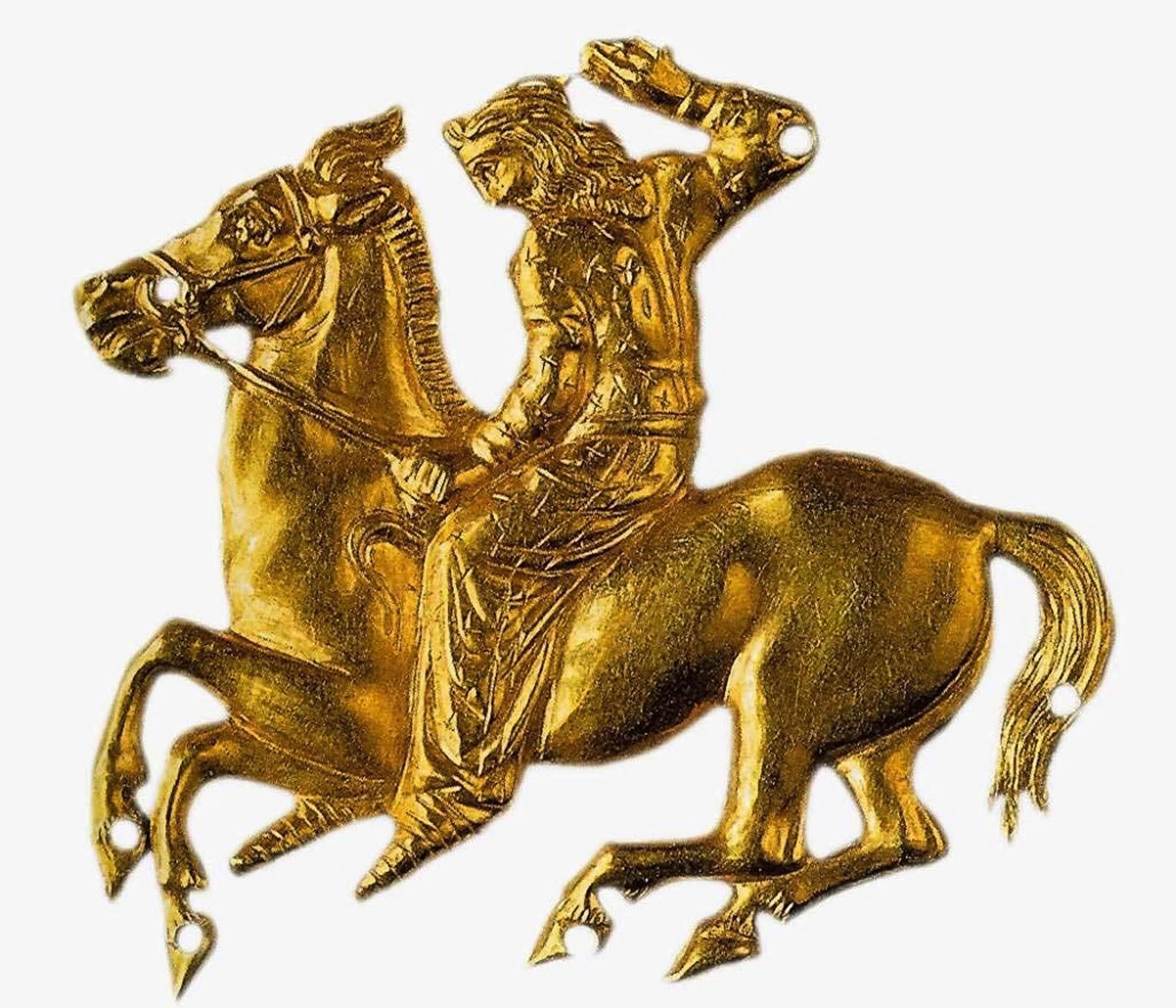
“The Saxons were a Scythian nation and were called Saca, Sacki, Sachsen.” Turner, Sharon (1768-1847) - The history of the Anglo-Saxons, from the earliest period to the Norman conquest. Publication date: 1852.
“It will be unnecessary to employ our time, in enumerating the many fallacious theories which have been framed, on the origin of our Anglo-Saxon ancestors. It will be more useful to select those few facts which may be gleaned from the writers of antiquity on this subject, and to state to the reader, rather what he may believe, than what he must reject.
The early occupation of Europe, by the Kimmerian and Keltic races, has been already displayed. The next stream of barbaric tribes, whose progress formed the second great influx of population into Europe, were the Scythian, German, and Gothic tribes.
They also entered it out of Asia. It is of importance to recollect the fact of their primeval locality, because it corresponds with this circumstance, that Herodotus, besides the main Scythia, which he places in Europe, mentions also an Eastern or Asiatic Scythia, beyond the Caspian and Jaxartes.
As these new comers pressed on the Kimmerians and Kelts, their predecessors, those nations retired towards the eastern and southern extremities of Europe, pursued still by the Scythian invaders.
This new wave of population gradually spread over the mountains, and into the vast forests and marshes of Europe, until, under the name of Germans, an appellation which Tacitus calls a recent name, they had not only reached the Rhine, but had also crossed it into France.
Here Caesar found one great body firmly settled, descended from them, whom he calls Belgae; though its component states had their peculiar denominations, besides a very large force of recent German invaders under the command of Ariovistus.
This second stock of the European population is peculiarly interesting to us, because from its branches not only our own immediate ancestors, but also those of the most celebrated nations of modern Europe, have unquestionably descended.
The Anglo-Saxons, Lowland Scotch, Normans, Danes, Norwegians, Swedes, Germans, Dutch, Belgians, Lombards, and Franks, have all sprung from that great fountain of the human race, which we have distinguished by the terms Scythian, German, or Gothic.
The ancient languages of these nations prove their ancient affinity, the contiguous chronology of their first origin, and their common derivation; and afford evidences of these truths, from which every one may satisfy his doubts or his curiosity.
We have works still existing in the ancient Gothic, and Saxon, as well as in the Frankish and Icelandic, in which the philologist will easily perceive their mutual relationship.
The comparison of these with the modern German, Danish, Dutch, Swedish, and Flemish, will equally demonstrate the kinship between the ancient parents and their existing descendants.
The first appearance of the Scythian tribes in Europe may be placed, according to Strabo and Homer, about the eighth, or according to Herodotus, in the seventh century before the Christian era. Herodotus likewise states, that the Scythians declared their nation to be more recent than any other, and that they reckoned only one thousand years between Targitaos, their first king, and the aggression of Darius.
The first scenes of their civil existence, and of their progressive power, were in Asia, to the east of the Araxes. Here they multiplied and extended their territorial limits, for some centuries, unknown to Europe. Their general appellation among themselves was Scoloti, but the Greeks called them Scythians, Scuthoi or Nomads.
To this judicious and probable account of Herodotus, we add the information collected by Diodorus. He says, that the Scythians, formerly inconsiderable and few, possessed a narrow region on the Araxes; but, by degrees, they became more powerful in numbers and in courage. They extended their boundaries on all sides; till at last they raised their nation to great empire and glory.
One of their kings becoming valiant and skillful in the art of war, they added to their territory the mountainous regions about Caucasus, and also the plains towards the ocean, and the Palus Maeotis, with the other regions near the Tanais.
In the course of time they subdued many nations, between the Caspian and the Maeotis, and beyond the Tanais. Thus, according to Diodorus, the nation increased, and had kings worthy of remembrance. The Sakai, the Massagetai, and the Arimaspoi, drew their origin from them.
The Massagetai seem to have been the most eastern branch of the Scythian nation. Wars arising between them and the other Scythic tribes, an emigration from the later took place according to the account which Herodotus selects, as in his opinion the most authentic, which occasioned their entrance into Europe. Such feuds and wars have contributed, more than any other cause, to disperse through the world its uncivilized inhabitants.
The emigrating Scythians crossed the Araxes, passed out of Asia, and invading the Kimmerians, suddenly appeared in Europe, in the seventh century before the Christian era. Part of the Kimmerians flying into Asia Minor, some of the Scythian hordes pursued them; but, turning in a direction different from that which the Kimmerians traversed, they missed their intended prey, and fell unintentionally upon the Medes. They defeated the Medes, pressed on towards Egypt, and governed those parts of Asia for twenty-eight years, till Cyaxares, the king of Media, at last expelled them.
The Scythian tribes however continued to flock into Europe; and, in the reign of Darius, their European colonies were sufficiently numerous and celebrated to excite the ambition of the Persian monarch, after his capture of Babylon; but all his efforts against them failed. In the time of Herodotus, they had gained an important footing in Europe.
They seem to have spread into it, from the Tanais to the Danube, and to have then taken a westerly direction; but their kindred colonies, in Thrace, had extended also to the south. Their most northward ramification in Europe was the tribe of the Roxolani, who dwelt above the Borysthenes, the modern Dnieper.
It would be impertinent to the great subject of this history, to engage in a minuter discussion of the Scythian tribes. They have become better known to us, in recent periods, under the name of Getae and Goths, the most celebrated of their branches.
As they spread over Europe, the Kimmerian and Keltic population retired towards the west and south. In the days of Caesar, the most advanced tribes of the Scythian, or Gothic race, were known to the Romans under the name of Germans. They occupied all the continent but the Cimbric peninsula, and had reached and even passed the Rhine.
One of their divisions, the Belgae, had for some time established themselves in Flanders and part of France; and another body, under Ariovistus, were attempting a similar settlement near the center of Gaul, which Caesar prevented. It is most probable that the Belgae in Britain were descendants of colonists or invaders from the Belgae in Flanders and Gaul.
The names Scythians and Scoloti were, like Galli and Kimmerians, not so much local as generic appellations. The different tribes of the Scythians, like those of the Kimmerians and Gauls, had their peculiar distinctive denominations.
The Saxons were a German or Teutonic, that is, a Gothic or Scythian tribe; and of the various Scythian nations which have been recorded, the Sakai, or Sacae are the people from whom the descent of the Saxons may be inferred, with the least violation of probability. Sakai-suna, or the sons of the Sakai, abbreviated into Saksun, which is the same sound as Saxon, seems a reasonable etymology of the word Saxon.
The Sakai, who in Latin are called Sacae, were an important branch of the Scythian nation. They were so celebrated, that the Persians called all the Scythians by the name of Sacae; and Pliny, who mentions this, remarks them among the most distinguished people of Scythia. Strabo places them eastward of the Caspian, and states them to have made many incursions on the Kimmerians and Treres, both far and near.
They seized Bactriana, and the most fertile part of Armenia, which, from them, derived the name Sakasina; they defeated Cyrus; and they reached the Cappadoces on the Euxine. This important fact of a part of Armenia having been named Sakasina, is mentioned by Strabo in another place, and seems to give a geographical locality to our primeval ancestors, and to account for the Persian words that occur in the Saxon language, as they must have come into Armenia from the northern regions of Persia.
That some of the divisions of this people were really called Saka-suna, is obvious from Pliny; for he says, that the Sakai, who settled in Armenia, were named Sacassani, which is but Saka-suna, spelt by a person unacquainted with the meaning of the combined words. And the name Sacasena, which they gave to the part of Armenia they occupied, is nearly the same sound as Saxonia.
It is also important to remark, that Ptolemy mentions a Scythian people, sprung from the Sakai, by the name of Saxones. If the Sakai, who reached Armenia, were called Sacassani, they may have traversed Europe with the same appellation; which being pronounced by the Romans from them, and then reduced to writing from their pronunciation, may have been spelt with the x instead of the k’s, and thus Saxones would not be a greater variation from Sacassani or Saksuna, than we find between French, Francois, Franci, and their Greek name, or between Spain, Espagne, and Hispania.
It is not at all improbable, but that some of these marauding Sakai, or Sacassani, were gradually propelled to the western coasts of Europe, on which they were found by Ptolemy, and from which they molested the Roman Empire, in the third century of our era. There was a people called Saxoi, on the Euxine, according to Stephanus.
We may consider these also, as a nation of the same parentage; who, in the wanderings of the Sakai, from Asia to the German Ocean, were left on the Euxine, as others had chosen to occupy Armenia. We may here recollect the traditional descent of Odin preserved by Snorre in the Edda and his history.
This great ancestor of the Saxon and Scandinavian chieftains is represented to have migrated from a city, on the east of the Tanais, called Asgard, and a country called Asaland, which imply the city and land of the Asae or Asians. The cause of this movement was the progress of the Romans.
Odin is stated to have moved first into Russia, and thence into Saxony. This is not improbable. The wars between the Romans and Mithridates involved, and shook most of the barbaric nations in these parts, and may have excited the desire, and imposed the necessity of a westerly or European emigration.”
KAF supplement:
Pliny the Elder, The Natural History. John Bostock, H.T. Riley, ed. London, 1855. Chap. 19— The nations of Scythia and the countries on the eastern ocean.
“Beyond this river are the peoples of Scythia. The Persians have called them by the general name of Sacæ,[1] which properly belongs to only the nearest nation of them.
The more ancient writers give them the name of Aramii. The Scythians themselves give the name of “Chorsari” to the Persians, and they call Mount Caucasus Graucasis, which means “white with snow.”
The multitude of these Scythian nations is quite innumerable: in their life and habits they much resemble the people of Parthia.
The tribes among them that are better known are the Sacæ, the Massagetæ,[2] the Dahæ,[3] the Essedones,[4]the Ariacæ,[5] the Rhymmici, the Pæsici, the Amardi,[6] the Histi, the Edones, the Came, the Camacæ, the Euchatæ,[7] the Cotieri, the Anthusiani, the Psacæ, the Arimaspi,[8] the Antacati, the Chroasai, and the Cetei; among them the Napæi[9] are said to have been destroyed by the Palæi.
-
The Sacæ probably formed one of the most numerous and most powerful of the Scythian Nomad tribes, and dwelt to the east and north-east of the Massagetæ, as far as Servia, in the steppes of Central Asia, which are now peopled by the Kirghiz, in whose name that of their ancestors, the Sacæ, is traced by some geographers.
-
Meaning the “Great Getæ.” They dwelt beyond the Jaxartes and the Sea of Aral, and their country corresponds to that of the Khirghiz Tartars in the north of Independent Tartary.
-
The Dahæ were a numerous and warlike Nomad tribe, who wandered over the vast steppes lying to the east of the Caspian Sea. Strabo has grouped them with the Sacæ and Massagetæ, as the great Scythian tribes of Inner Asia, to the north of Bactriana.
-
The position of the Essedones, or perhaps more correctly, the Issedones (Wusun), may probably be assigned to the east of Ichim, in the steppes of the central border of the Kirghiz, in the immediate vicinity of the Arimaspi, who dwelt on the northern declivity of the Altaï chain.
A communication is supposed to have been carried on between these two peoples for the exchange of the gold that was the produce of those mountain districts. -
They dwelt, according to Ptolemy, along the southern banks of the Jaxartes.
-
Or the Mardi, a warlike Asiatic tribe. Stephanus Byzantinus, following Strabo, places the Amardi near the Hyrcani, and adds, “There are also Persian Mardi, without the a;” and, speaking of the Mardi, he mentions them as an Hyrcanian tribe, of predatory habits, and skilled in archery.
-
D’Anville supposes that the Euchatæ may have dwelt at the modern Koten, in Little Bukharia. It is suggested, however, by Parisot, that they may have possibly occupied a valley of the Himalaya, in the midst of a country known as “Cathai,” or the “desert.”
-
The first extant notice of them is in Herodotus; but before him there was the poem of Aristeas of Proconnesus, of which the title was ‘Arimaspea;’ and it is mainly upon the statements in it that the stories told relative to this people rest—such as their being one-eyed, and as to their stealing the gold from the Gryphes, or Griffins, under whose custody it was placed.
Their locality is by some supposed to have been on the left bank of the Middle Volga, in the governments of Kasan, Simbirsk, and Saratov: a locality which is sufficiently near the gold districts of the Uralian chain to account for the legends connecting them with the Gryphes, or guardians of the gold. -
The former reading was, “The Napæi are said to have perished as well as the Apellæi.” Sillig has, however, in all probability, restored the correct one.”
Yuri Alexandrovich Zuev, Kyrgyzy-Burut (“Griffin,” “Berkut”). On Totemism and Principles of Ethnonym Formation”
“The ethnonym Kyrgyz, judging by Greek reports about griffins, originated during the era of totemism and reflected the designation of a totemic animal (“griffon,” “eagle”).
Its explanation should likely be sought in Indo-Iranian linguistic material, in the lexicon of the inhabitants of the Altai, who, as Herodotus writes, ‘separated from the Royal Scythians.’
It is probable that the close connection between ‘griffins’ and the Argippaeans—‘swift riders’—is indicated by the standard phrase used by Greco-Roman writers:
‘The griffins will reunite with the horses.’
The cult of the eagle, which in ancient beliefs was conflated with the griffon, has been known since the time of Aristeas and Herodotus.
In the Arimaspea, which, as demonstrated by K. Meuli, is imbued with the spirit of shamanism, the farthest peoples of the northwest are depicted as fantastical creatures.
The people known as the ‘guardians of the griffins’ gold,’ when localized alongside their western neighbors, the Argippaeans (‘swift riders’), in Dzungaria, turn out to be inhabitants of the Sayan-Altai region, commonly referred to as the Hyperborean Mountains. Some confirmation of this is also found in Chinese documents.
For the designation of the eagle and griffon in Indo-Iranian languages, the term karkasa is recorded: Avestan kahrkasa, Middle Persian and Pahlavi kargas (“vulture”), Pamir karyez (“eagle”), Sogdian carkas (crks), Ossetian cxrgxs (“eagle”), and from there, Mansi sarkes and Udmurt zuges (“eagle”).
Echoes of this meaning can be found in the Turkic lexicon of the Central Asian tafsir, where the word kargas (kerges) designates “griffon” or “mythical griffon.”
L. Z. Budagov, with the notation ‘p’ (Persian borrowing), gives kérkés the meaning of “legendary bird feeding on corpses” or “eagle.” These forms directly coincide with the designation of the Kyrgyz in the 15th–16th centuries as kerges, kergesh, as noted by K. I. Petrov.
As early as G. F. Müller, it was believed that the Yenisei Kyrgyz were known under the name buruts; this was supported by V. V. Radlov and partially by G. Goworth.
The identification of the Yenisei Kyrgyz with the Buruts was convincingly reinforced by A. Abdykalykov, who introduced new archival materials supporting this claim. Today, this identification can be considered established and widely accepted.
Equally indisputable is the use of the term burut concerning the Tian Shan Kyrgyz. This is most clearly documented in Chinese sources of the 18th–19th centuries. The following words, attributed to Almambet in the Kyrgyz epic Manas, are particularly noteworthy:
“…In the cold jailoo on campaign, The Burut people gathered. Their chief khan is Manas, He is in our records—Manas, A lion among the Kyrgyz lions—Manas!”
The semantics of the ethnonym can also be observed in reference to the Kachin (Khakassia) people, whose origins are in one way or another linked to the ancient Kyrgyz.
The Kachin clan (burut, var. burut, purut, burkut—literally “berkut,” “eagle”) considers the eagle their totemic animal. Among them, it served as the progenitor of shamans, the protector of the clan, and its eponym.” - Yuri Alexandrovich Zuev, Kyrgyzy-Burut (“Griffin,” “Berkut”). On Totemism and Principles of Ethnonym Formation”
DNA 🧬
Rozhansky and A. Klyosov:
"It is shown that the R1a1 haplotypes from Central Asia (Kyrgyzstan) display the greatest similarity to Scandinavian haplotypes of the same R1a1 haplogroup.
The common ancestor of the “Kyrgyz” haplotypes and the “young” Scandinavian haplotypes lived 2,800–3,000 years ago—this marks the beginning of the re-settlement of Europe by carriers of R1a1 haplotypes from the Russian Plain.
Both the “young” Scandinavian haplotypes of this haplogroup and three-quarters of the “Kyrgyz” haplotypes share a common ancestor who lived in the middle of the 1st millennium AD.
All of this corresponds with the notion that in the middle of the 1st millennium AD, during the era known as the Great Migration Period, there was a migration of haplotype carriers from “Asia” (which could mean either the Russian Plain or Central Asia, including present-day Kyrgyzstan), descendants of the Aryans (haplogroup R1a1) during their migration into India and Iran.
According to data obtained from the analysis of Scandinavian haplotypes of haplogroup Q, this migration may have been joint or parallel with carriers of haplogroup Q, who in turn likely originated from southern Siberia, with a common ancestor around 12,000 years ago.”
Read more: https://www.kyrgyzamericanfoundation.org/post/vikingskyrgyz
#archeology #archeologist #civilizations #archeological #castle #ancient #history #historyfacts #historynerd #scythians #huns #kyrgyz #turks #nomads #empires #sarmatians #история #археология #цивилизации #скифы #сарматы #тюрки #киргизы #гунны #pasyryk #kazakh #massagetean #cumans #kipchaks #GoldenHorde #RussianEmpire #Yenisei #Siberia #Khoton #mongolia #cumans #kipchaks #bulgars #кипчаки #куманы #булгары #шорцы #тадарлар #shors #Shorians #vikings scandinavia #sweden #norway #bashkirs #башкиры #saxons #anglosaxon #celts