

North Korea and Christianity: The Beginning of a Connection or a Bad Relationship
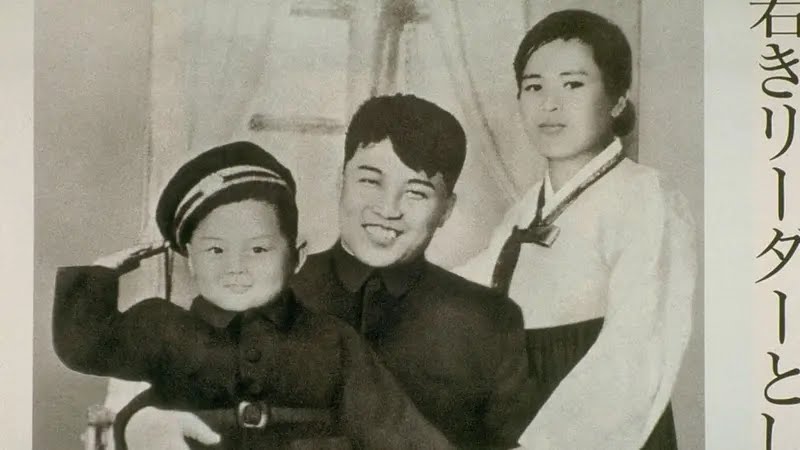 (Kim Il-sung family photo)
North Korean founder Kim Il-sung was born into a devout Christian family. His maternal grandfather, Kang Don-wook, was a pastor in Pyongyang, and his maternal uncle was also a pastor. Kim Il-sung attended church with his parents and was baptized.
Thae Yong-ho, former North Korean diplomat to the UK, told the Chosun Ilbo in an interview last May that Christianity is the religion North Korea fears most.
“Because Kim Il-sung came from a Christian family, he knew the nature of Christianity too well. He knew that if Christianity was left alone, he couldn’t continue the hereditary succession of power,” he said.
North Korean authorities claim there is “religious freedom” in North Korea, but according to defectors, this is not the case. Those caught engaging in religious activities are said to receive harsh punishments.
Following the PyeongChang Winter Olympics in February, exchanges between North and South Korea have been detected in various fields including sports, culture, and economics.
In sports, unified teams were formed and friendly matches were held in basketball; Korean performances were held in North Korea and North Korean performances were held in South Korea.
Additionally, they agreed to excavate the Manwoldae ruins in Kaesong, and the inter-Korean liaison office in Kaesong opened on the 14th. However, religion was excluded.
How did a regime founded by a Christian come to suppress Christianity?
‘The Beginning of the Connection’
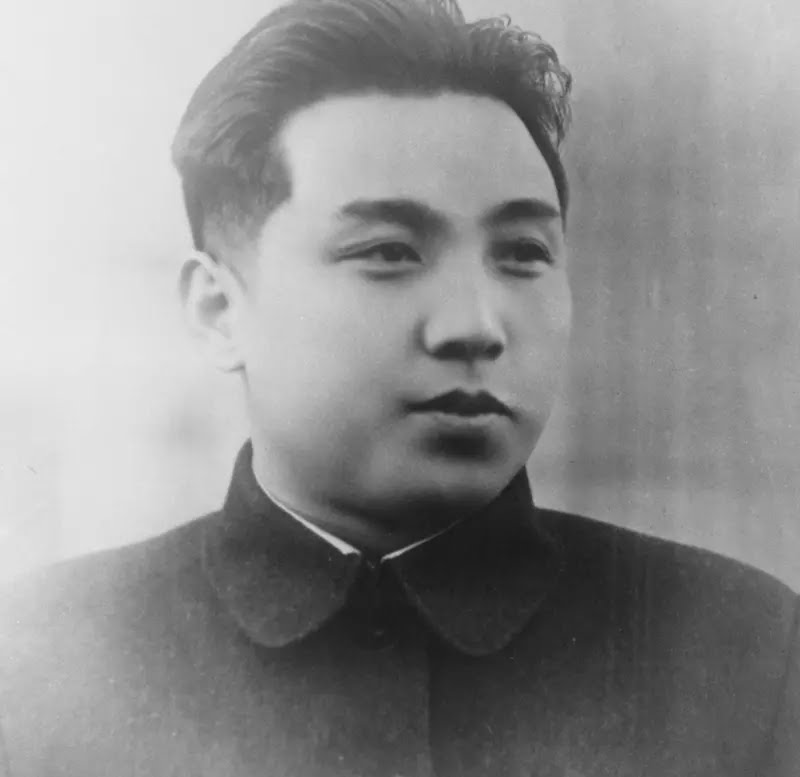 (Kim Il-sung in his youth)
Kim Il-sung was born on April 15, 1912, in a farming household in the outskirts of Pyongyang. His father, Kim Hyong-jik, was an elementary school teacher who engaged in missionary work. His mother, Kang Ban-seok, was also a believer.
At a young age, he moved with his parents to Jilin Province in northern Manchuria, where he met Pastor Son Jung-do, who served as the 6th pastor of Jeongdong First Church.
Pastor Son Jung-do’s children lived like siblings with Kim Il-sung. To inquire about Kim Il-sung during this period, we met Son Myung-won, the eldest grandson of Pastor Son Jung-do.
He told BBC Korea, “I heard that after Kim Il-sung’s father passed away, he came to my grandfather, who had been his father’s schoolmate,” adding, “They lived like family and (Kim Il-sung) attended church diligently.”
In particular, Son Won-tae, Pastor Son’s second son, and Kim Il-sung were close friends, playing war games together. The two met in Pyongyang about three years before Kim Il-sung’s death. At that time, Kim Il-sung had been baptized by Pastor Son Jung-do.
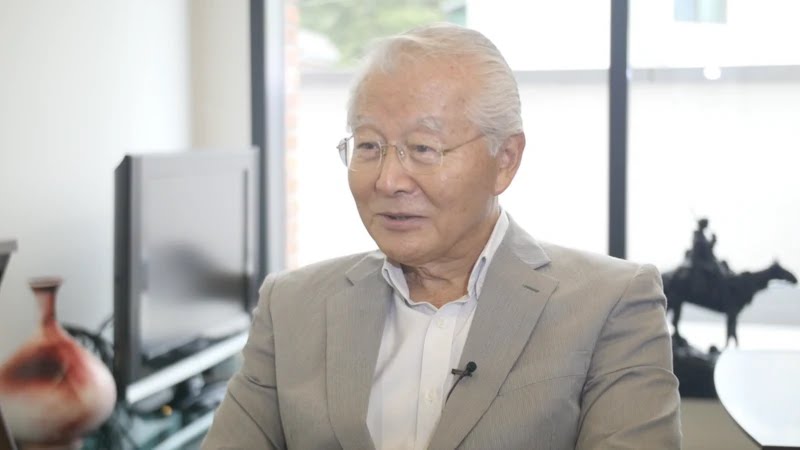 (Son Myung-won, the eldest grandson of Pastor Son Jeong-do, speaking with BBC Korea.)
Son Myung-won said, “At that time, Pyongyang was practically the birthplace of Christianity, with many missionaries coming to evangelize,” adding, “Baptism is important, but in fact, from Pyongyang onwards, Kim Il-sung’s family had deep ties with Christianity.”
Kim Il-sung is said to have later remarked, “Although Pastor Son Jung-do had different ideology, he was truly a patriot who devoted himself to the nation.” This suggested he was no longer a Christian believer. The exact point at which he abandoned his faith is unknown.
Nevertheless, Son Myung-won says that Kim Il-sung ordered a memorial project for Pastor Son Jung-do. This is why the Son Jung-do Pastor North-South Academic Discussion Conference was held in North Korea in 2003.
According to the communist view of religion, “religion is the opium of the people.” When asked, “Isn’t it strange that North Korea commemorates a pastor?” Son Myung-won replied, “They’re socialist, but ultimately they’re still human, aren’t they?”
‘North Korea’s “Pastors”’
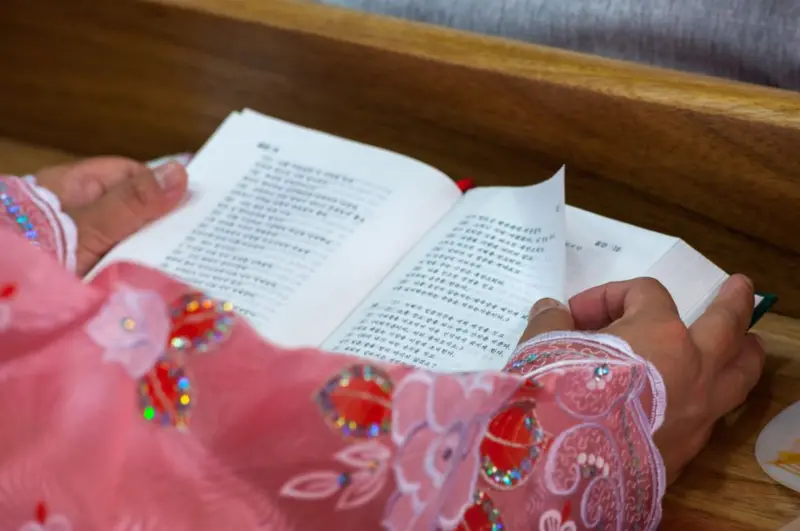
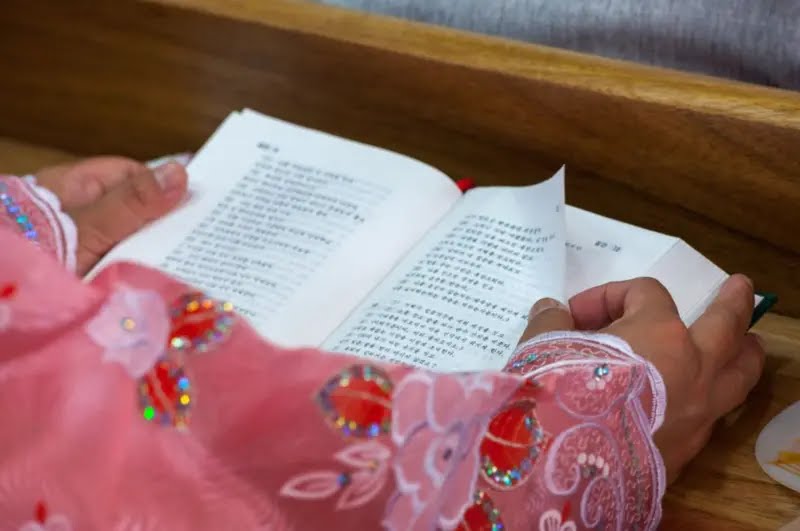 (A believer reading the Bible at Bongsu Church in North Korea)
According to diplomat Thae Yong-ho, North Korea demolished churches on a large scale after the war to suppress Christianity. The reason was to deify Kim Il-sung. The number of destroyed churches in North Korea identified by the Korean Christian Federation’s North Korean Church Reconstruction Committee in June 2000 was about 3,000.
However, the connection between the Kim Il-sung family and Christianity did not end there.
Pastor Kang Ryang-wook, a relative of Kim Il-sung (his mother’s third cousin once removed), founded the Korean Christian Federation (KCF), and three generations have held the leadership position, with his grandson Pastor Kang Myung-chol currently serving as chairman.
However, Korean Christianity does not recognize the KCF as Christian.
Pastor Kim Sung-eun of Caleb Mission told BBC Korea, “(In Korean Christianity) pastors must be ordained for ministry according to regulations, but pastors belonging to the KCF are not.”
To propagate externally that there is religious freedom, they built churches and held services and hymns, but in the process, some genuine believers emerged, Thae Yong-ho revealed.
Thae said, “With 1980 as a turning point, Bongsu Church and Jangchung Cathedral were built in Pyongyang. They selected ‘loyal women’ residing near Bongsu Church or Jangchung Cathedral,” adding, “When those who were just pretending developed real faith, everything changed. Many people started coming to church or cathedral before service time.”
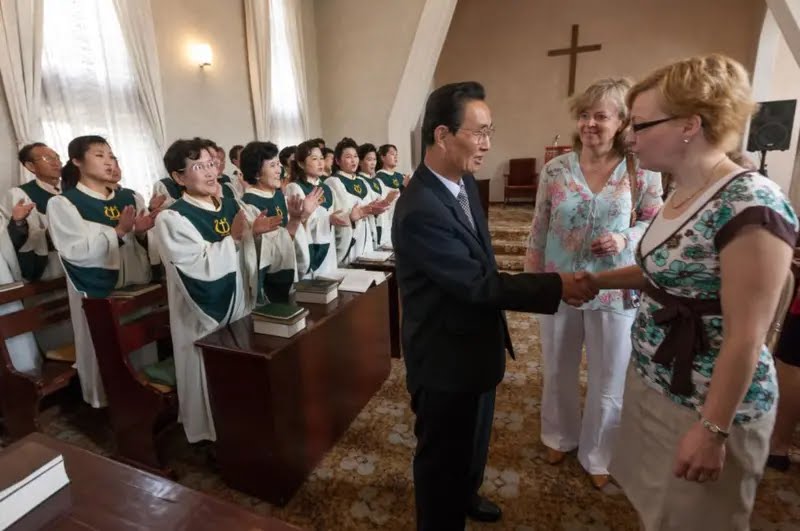 (Foreign tourists visiting Chilgol Church in Pyongyang)
The authorities then arrested the “real believers” and decided not to build any more churches or cathedrals. In Korean Christianity as well, the dominant opinion is that there are not many Christian believers in North Korea.
According to the ‘2015 North Korea Religious Freedom White Paper’ by the Database Center for North Korean Human Rights’ North Korean Human Rights Records Preservation, among 10,183 respondents who defected from North Korea from 1997 to 2015, 10,146 (99.6%) answered that religious activities cannot be freely practiced in North Korea.
Pastor Kim Sung-eun, who has been doing “North Korean defector ministry” for over 20 years, also said that Christian believers in North Korea are “really a very small number.” He added that “there are almost no people who risk death to keep their faith.”
Although Christian pastors or believers recognized by the international community in North Korea may be few, the number of people who have encountered the Bible appears to be increasing.
According to the North Korean Human Rights Records Preservation, only 9 defectors before 2000 had experience seeing the Bible, but among those who defected afterward, 424 answered that they had encountered the Bible.
However, after Chairman Kim Jong-un took power, he ordered the “arrest of residents who contacted Christianity,” and there are said to be active movements to arrest North Korean defector Christians even in China.
<iframe width=“400” height=“500” frameborder=“0” src=“https://www.bbc.com/korean/av-embeds/news-45507082/vpid/p069gn8j”></iframe> (The wife of a missionary who has been detained in North Korea for more than four and a half years has appealed to the South Korean government to help secure her husband’s repatriation.)
‘Defector Ministry’
The vast majority of North Korean defectors escape with the help of Christian missionaries. Some say 90% of defectors received help.
In the process of settling in South Korea, they often receive help from churches as well.
There are about 20 large churches in South Korea with North Korean defector communities, and about 10 churches centered around defectors.
However, Korean pastors who do “North Korean ministry” point out that there are dilemmas in this process.
Some defectors attend theological seminary in South Korea and pledge to do missionary work targeting North Korean residents or defectors. However, they overlook that missionary work is arduous and requires many sacrifices, and some eventually give up.
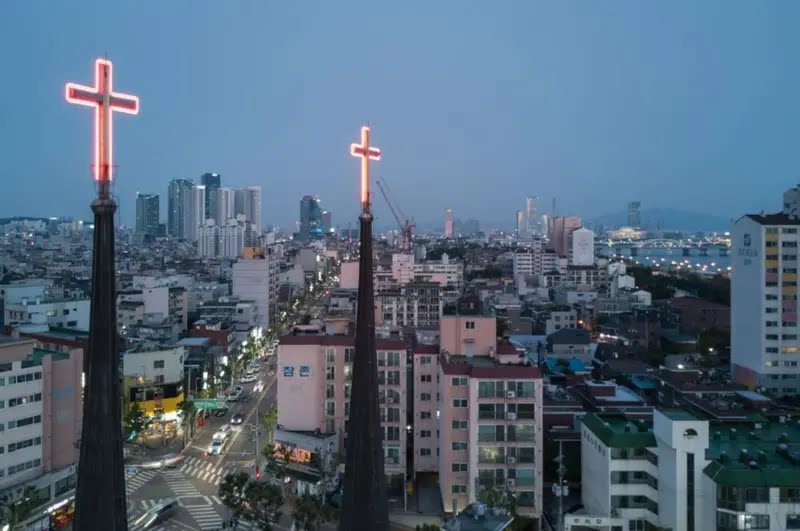
Pastor Kim Sung-eun says that some defectors “think ‘missionaries are wealthy people who give’ because they received material help from missionaries during the defection process,” and therefore sometimes discourage defectors from attempting missionary work.
“Sometimes the people we brought become those who hate us the most,” he says.
‘There Will Be Exchanges’
On the other hand, there is a pastor North Korea welcomed: American pastor Billy Graham.
In 1992, he became the first Western pastor to visit North Korea and meet Chairman Kim Il-sung. North Korea invited Pastor Graham and his wife first because Ruth Graham, his wife, had attended a foreign school in Pyongyang.
At that time, Pastor Graham gifted Chairman Kim a Bible and his own books, and visited Pyongyang again two years later.
The connection led to humanitarian aid.
Pastor Franklin Graham, son of Pastor Graham, created a private North Korean aid organization called “Samaritan’s Purse,” and Pastor Dwight Linton, who served as interpreter for Pastor Graham during his visit to North Korea, and his family also established a North Korean aid organization providing humanitarian assistance.
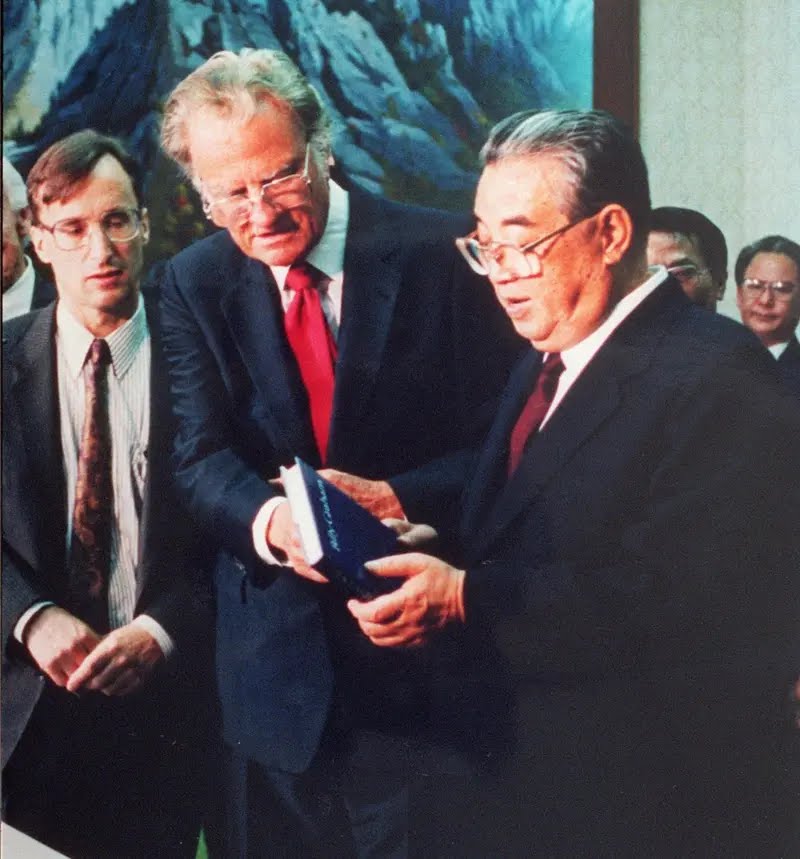 (In April 1992, Reverend Billy Graham visited Pyongyang and presented Chairman Kim Il-sung with his books and a Bible.)
Given that religious exchanges can lead to aid, some believe that religious exchanges between North and South Korea will soon become active.
The fact that North Korea’s constitution states there is religious freedom was not only with international relations in mind, but some opinions suggest it also means they won’t completely block religious exchanges.
Additionally, Lee Woo-young of the University of North Korean Studies revealed that the oppression of some pastors is not significantly different from China, in that they are oppressed for engaging in activities different from their entry permit conditions.
Neither North Korea nor China issue “religious visas,” and from the perspective of North Korea and China, helping defectors and evangelizing to defectors with visas like “business visas” can only be viewed as illegal activity.
Professor Lee told BBC Korea, “North Korea also values practical benefits,” adding, “In the past, they emphasized (oppression) by connecting Christianity with ‘anti-American’ sentiment, but religious exchanges often lead to aid, and I believe they will exchange based on practical needs.”