

·
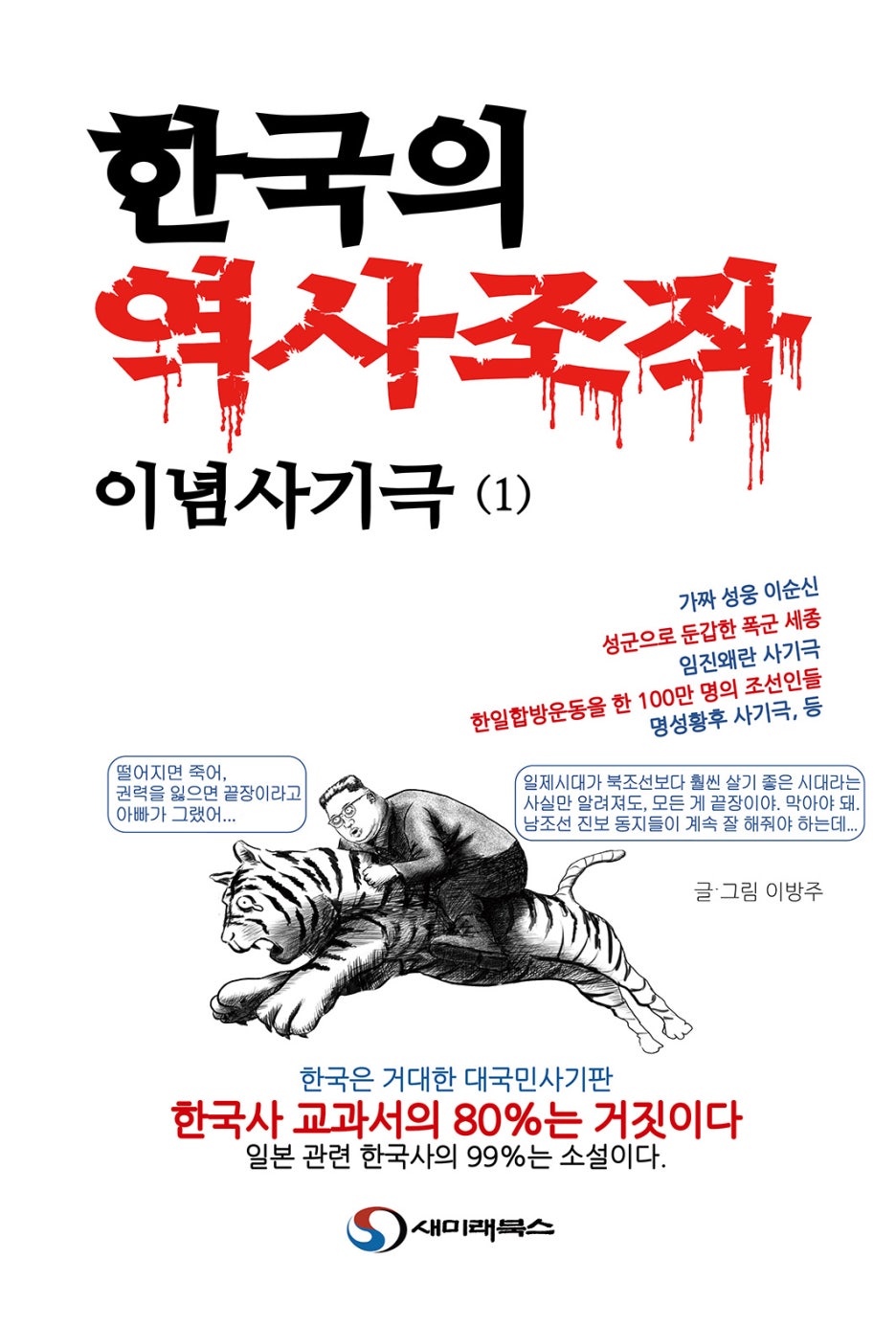
The “Korean History Textbook Trash” fabricated by the “National Institute of Korean History” fraudsters
(https://m.blog.naver.com/PostView.naver?blogId=smrbooks&logNo=222700630284&navType=by)
<The Left is the Main Criminal of Job Loss and the Declining Birth Rate, and the Main Reason for the Left’s Rise is the Trashy Korean History Textbook>
This book presents clear evidence that 99% of Korean history related to Japan—including the Japanese occupation, exploitation, massacres, comfort women, forced labor, the Imjin War, the Treaty of 1592, secret envoys, and Empress Myeongseong—is fiction.
If any of these points are clearly refuted as fact and not fabricated, this book will be shut down and the company will cease publishing. I also offer a hundredfold apology and will jump into the Han River. However, there has never been a rebuttal to this, and there never will be. Truth will prevail.
 |
|---|
| <Crowds of Koreans waving Japanese flags cheering the fall of Nanjing (December 13, 1937)> |
The truth, even if it hurts, must be known. For the people’s right to know…
Which do you prefer: truth or peace of mind?
What if the truth is that the person you once hated and considered your mortal enemy
and the person you once thought was your savior have switched places?
Your peace of mind may be greatly shaken.
However, to find a righteous future, you must find your true memories.
The truth, even if it hurts, must be known…
And this book was written for the people’s right to know.
 |
|---|
| <Waves of Japanese flags waved by Koreans cheering the successive victories on the Chinese front in 1941> |
Korea’s Historical Manipulation and Ideological Fraud (Prologue)
"80% of Korean history textbooks are fiction?
This is absurd, considering the credibility of the state and schools."
However, after 17 years of research in this field, the feeling of betrayal and despair—“Have I been deceived to this extent?”—is indescribable. The lies in Korean history textbooks are even more numerous.
It’s hard to find a country as deeply divided as Korea, or one so obsessed with its past.
The cause of this is politically motivated indoctrination into a false national history.
No one would be sane if they were indoctrinated with false memories. Let me give you an example.
 |
|---|
| <Crowds waving Japanese flags at Daejeon Station to see off the Manchurian expedition, January 2, 1934> |
History textbooks thoroughly conceal the fact that Joseon was a country strewn with corpses that starved to death.
Until the end of the Joseon Dynasty, tens of thousands to hundreds of thousands starved to death every year, totaling 60 million.
The textbooks fail to address the reality of Joseon, the poorest country on earth, even looking up to North Korea.
Joseon was the only country on earth that practiced slavery, enslaving its own people generation after generation.
Even if people earned money, it was taken away by the ruling class, leaving the people to starve endlessly.
However, history education conceals this fact, as well as how they escaped this suffering.
 |
|---|
| <Seoul (Dongdaemun) in the late Joseon Dynasty> |
 |
|---|
| <Downtown Seoul as seen from Dongdaemun in the late Joseon Dynasty> |
*(Famine) Relief is lacking, leaving corpses strewn in pits [Gojong 42 (1905)-2-8]
*What’s there to say when so many people are starving and freezing to death?
This pitiful poverty is also too dire. [Gojong 41 (1904) - January 30]
*There is no money to collect and bury the frozen bodies within the five districts of Hanseongbu… [Gojong 34 (1897) - January 14]
*They are wandering, unable to escape freezing to death or starving to death. [Gojong 31 (1894) - October 13]
*The starving people are suffering everywhere, and it is a miserable situation. [Gojong 21 (1884) - November 9]
*(In the north) nine out of ten households are empty due to famine and the Hopyo disaster. [Gojong 17 (1880) - December 28]
*Every year, there are famines… corpses of starvation are everywhere. [Gojong 13 (1876) - August 9]
*People continue to starve to death. There are. [Gojong 2 (1865) - 6-10]
*The people starved to death, filling the ditch… [Cheoljong 5 (1854) - 1-25]
*Countless cases of starvation [Heonjong 3 (1837) - 11-10]
*Hundreds of thousands of deaths…very few people had property or a livelihood to support themselves.
Now, even those people struggle to make ends meet, suffering from the famine.
People without property or a livelihood…corpses litter the streets… [Sunjo 21 (1821) - 8-22]
*Bodies of starvation litter the streets. [Sunjo 10 (1810) - 3-7]
*It is said that it is difficult to count the number of people who starved to death. [Jeongjo 19 (1795) - 10-2] ☞The Golden Age of Joseon
*Jeju About 6,000 people starved to death [Yeongjo 41 (1765) - December 16]
*Nearly half of the population died due to the famine [Yeongjo 28 (1752) - February 19]
*Corpses of those who starved to death lay face-to-face [Yeongjo 18 (1742) - March 5] ☞The Golden Age of Joseon
Excerpt from <Korean History Manipulation: Ideological Fraud>, Volume 1, Page 21 (from the The Veritable Records of the Joseon Dynasty)
*Bandits were rampant, and the people’s lives were in jeopardy, even morning and night [Sunjong 2 (1909) - December 4]
*The bandits’ fury reached the innocent… Thousands of houses were burned to the ground, leaving villages desolate and desolate [Sunjong 1 (1908) - February 28]
*Former Champan Heo Wi became the ringleader of the bandits, leading a band of some 700 men to pillage each village… [Sunjong’s accession year (1907) - October 15]
*Magistrates seized power, soldiers invaded, and plundered, claiming to be volunteers [Gojong 43 (1906) - September 24]
*Bandits plundered everywhere, killing people and burning houses [Gojong 43 (1906) - March 11]
*Public unrest was so intense that there was no hope of calming down, and bandits were on the rise. [Gojong 42 (1905) - May 1]
*The plunder of bandits has devastated everything, and even military action cannot suppress it. [Gojong 41 (1904) - July 15]
*The people are starving, and bandits are rampant, blocking roads. [Gojong 41 (1904) - January 8]
*Due to the famine, bandits… The situation is dire everywhere, but the threat of bandits is said to be even more severe in the three southern provinces. [Gojong 40 (1903) - July 1]
*The alarm from bandits is intense. [Gojong 39 (1902) - July 20]
*Report on the Daejeong Rebellion in Jeju Island. [Gojong 38 (1901) - May 31]
*Roads are being plundered in and around Gyeongseong, and even the roads are blocked. [Gojong 36 (1899) - January 15]
*Bandits were rampant… looting was occurring everywhere [Gojong 33 (1896) - December 26]
*Due to the bandit riots, over 600 houses were burned in Seongju, and in Hadong, the entire fortress was reportedly burned down. [Gojong 32 (1895) - October 1]
*Due to the rampage of the Donghak guerrillas, 81 people were killed in Geumsan County and Yongdam County, 972 houses were burned, and 44 government buildings were burned down. [Gojong 32 (1895) - January 8]
*In Goesan, over 500 houses were burned down due to bandit riots [Gojong 31 (1894) - October 29]
*The State Council dealt with the situation in Gaeseong, where a civil unrest had broken out. [Gojong 31 (1894) - November 24]
*The thieves’ unrest has become more severe, with groups roaming the streets in broad daylight, robbing shops and plundering the goods of passersby. [Gojong 30 (1893) - October 29]
*Regarding the punishment of those who caused the uprising in Pyeongan Province… [Gojong 30 (1893) - February 23]
*The thieves have become more numerous, plundering in broad daylight within the capital. [Gojong 28 (1892) - December 24]
*The thieves’ disturbances have become more severe within the capital. [Gojong 27 (1891) - March 8]
*The thieves of old feared being discovered, but today’s thieves are more worried about being unknown. [Gojong 24 (1888) - March 29]
*There is no place without thieves and no place without uprising. [Gojong 23 (1887) - August 16]
*Report from the State Council on the Uprising in Tosan County, Hwanghae Province [Gojong 22 (1886) - January 4]
*Regarding treason and treason…for the execution of a swindler…as a lowly slave class [Gojong 21 (1884) - December 13]
*In broad daylight, 60 to 70 robbers rob merchants’ property, and they often commit robberies in the capital city. They are all said to be armed with guns and swords [Gojong 20 (1884) - June 15]
*The number of robbers is said to be in the hundreds, or even 700 or 800… [Gojong 18 (1882) - March 23]
*They attempted to invade Ganghwa Island first to establish a lair, and then seize weapons and head for Seoul. He committed treason… treason… death by assassination… [Gojong 18 (1881) - October 10
Excerpt from <Korean History Manipulation: Ideological Fraud>, Volume 1, Page 27 (from The Veritable Records of the Joseon Dynasty)
Even after the Japan-Korea Treaty of 1915, the fundamental historical narrative of a million Joseon people, witnessing the end of the horrors of starvation and slavery, leading the anti-feudal Japan-Korea Annexation Movement to overthrow the feudal ruling class, was completely overturned.
They teach only the false history of a glorious nation being occupied, exploited, and massacred.
Can a people who have been indoctrinated with false national history and taught only hatred truly be considered normal?
 |
|---|
| <Seoul in the 1930s> |
Hundreds of thousands of Koreans committed all manner of atrocities on the continent, claiming they were advancing there.
Yet, Korean history textbooks portray Korea as if it were fighting Japan on the side of the United States and the Allied Powers,
and even portray them as victims, portraying them as suffering saints.
They also thoroughly conceal from the public the fact that over 800,000 Koreans volunteered for the Japanese army,
and that the Provisional Government’s Korean Liberation Army numbered fewer than 339.
The competition rate for Koreans enlisting in the Japanese army averaged over 30:1,
and even soared to 62:1, leading to some suicides after failing to enlist.
Almost the entire nation enthusiastically supported the invasion of the continent.
Most would not believe me if I told them that there were 148 Korean war criminals in the Pacific War.
 |
|---|
| <Waves of Japanese flags waved by Koreans cheering the successive victories on the Chinese front in 1941> |
Brainwashed by a false national history,
the people have become “blind citizens with amnesia,” unaware of whether they are victims or invaders.
The moment they believe Korean history textbooks and media are factual, the people become fools.
Who is worse: an aggressor who apologizes, or an accomplice in the aggression who pretends to be a victim?
 |
|---|
| <Seoul in the Late Joseon Dynasty> |
Let’s move on from this. According to declassified documents from the former Soviet Union,
Kim Il-sung was a Soviet Army captain who passed the written and interview exam with Stalin, beating Pak Hon-yong.
If the North Korean people had known this, would they have considered Kim Song-ju (Kim Il-sung) their leader?
If the people begin to think, “Why would a Soviet Army captain become our leader?” then power will not last long.
Having already killed tens of thousands of people for power, he must never relinquish power.
Therefore, to maintain power, he must become a “hero,” and the means by which he achieves this is through the manipulation of history.
 |
|---|
| <Seoul in the 1930s> |
History is dictated by the victor. In an independent nation, the independence fighters are the heroes, in a annexed nation, the annexation fighters are the heroes, and the losers are inevitably the villains. Heroes must be “saviors,” and to mold the victors into saviors, the losers are inevitably taught to be villains.
Before his unexpected appearance, we must be indoctrinated with the idea that this was a horrific hell,
and we must be made to believe that our people lived through a horrific, dark age of nightmare, devoured by this villain, like a hungry wolf.
 |
|---|
| <Girls of the Joseon Dynasty (Joseon women were not even allowed to receive elementary education)> |
However, as I will reveal later, the Japanese colonial era was a time of far greater freedom and prosperity than North Korea today.
It may be hard for Koreans, who have only been educated about the horrific exploitation suffered during the Japanese colonial era, to believe this,
but it was Japan and its pro-Japanese collaborators who liberated Korea from the horrific starvation and slavery,
and the amount of money Japan invested to solve Korea’s hunger was astronomical.
However, education in both North and South Korea must thoroughly conceal this fact.
If North Koreans learn that “North Korea is a country far poorer and suffers far more horrific human rights abuses than during the Japanese colonial era,”
can the Kim dynasty endure?
If North Koreans believe that “independence was the cause of its downfall,” can power continue?
The more North Korea falls, the more the Japanese colonial era must become a far worse era than North Korea.
If the “Japanese colonial era = nightmare era” proposition is broken, the Kim dynasty will be in danger of collapse,
and the progressive faction of Kim Il-sung’s Juche ideology in South Korea, which has supported the North Korean regime, will also be shaken to its core.
Most of them are also deceived…
 |
|---|
| <Haeundae Beach, Busan, in the 1930s> |
Former North Korean Workers’ Party Secretary Hwang Jang-yop revealed that there were 50,000 spies in South Korea.
If you were Kim Il-sung or Kim Jong-il, what would you have them do first?
That there is no massive spy network infiltrating South Korea? That North Korea is incapable of planting spies?
East Germany had 20,000 spies, the North Vietnamese planted 30,000 spies in South Vietnam, and even a leading presidential candidate in South Vietnam was a spy. Is North Korea foolish?
If I were the Kim King, I would have taken control of South Korea’s history and ideology.
I would have planted my own people in academia, abused academic freedom to manipulate national history, and cultivated my own people.
Manipulating the people’s memories is necessary to divide the enemy, maintain power, and increase the likelihood of communist unification.
 |
|---|
| <Seoul’s Namdaemun (Sungnyemun) in the late Joseon Dynasty> |
But is that enough to maintain power?
Another thing is needed: brainwashing the masses with ideology and thought, turning them into mental slaves.
Since physical espionage operations have their limits,
the method involves instilling a false past and a false future, creating a loyal following behind enemy lines.
Simply put, the concept should be, "I am the hero who saved you from a terrible nightmare, and I am a superhuman who will lead you to a future utopia.
Follow me and serve me faithfully."
 |
|---|
| <Seodaemun, Seoul in the late Joseon Dynasty> |
History, politics, and ideology are, in fact, a single entity, overflowing with a small number of respected swindlers and a vast majority of courageous fools who are deceived. The most useful of these swindlers are the courageous fools who believe themselves to be righteous.
Memories are manipulated to incite hatred and revenge, and ideological brainwashing is used to create courageous pawns.
The North Korean regime’s deep involvement in the manipulation of Korean history and ideological deception—if citizens fail to understand the larger picture and solely rely on the history taught in textbooks, they are vulnerable to deception. Therefore, this book will address these historical, political, and ideological deceptions together.
 |
|---|
From the North Korean regime’s perspective, the only countries that can aid South Korea in an emergency are the United States and Japan. Therefore, they must drive discord between South Korea and these free allies, leaving South Korea isolated. This, along with China, will enable communist unification of South Korea.
From the Chinese regime’s perspective, to prevent South Korea, the United States, and Japan from uniting and to protect the North Korean regime, they have no choice but to manipulate discord among them. This is a strategy that applies regardless of whether the North Korean or Chinese regimes are involved.
To maintain power, North Korea needs an external enemy, and to prevent South Koreans from discerning their enemies, they must create the root cause of division and divide them. Therefore, the primary mission of spies and pro-North Korean figures is to drive discord between South Korea and the United States and Japan. This strategy will be used regardless of who becomes North Korea’s feudal king.
 |
|---|
| <Excerpt from Volume 1, Page 29 of “Korea’s Ideological Fraud: Manipulating History”> |
However, in South Korea, there clearly exists a massive force that remains silent on the ongoing atrocities of communist blocs like North Korea and China, while only exaggerating the past-perfect wrongdoings of the liberal democratic bloc, the United States and Japan, to vilify and sow discord.
The recent conflict between South Korea and Japan stems from the manipulation of national history, and its essence lies in the conflict between the left and the right, and the war between the South and the North.
None of South Korea’s problems fit into the puzzle without the manipulation of 50,000 North Korean spies.
If North Korea did not establish a massive spy network, it would be foolish and idiotic.
As revealed by Hwang Jang-yeop and others, they have no choice but to mobilize forces they have infiltrated into academia, politics, education, law, media, and culture through infiltration, Kim Il-sung Scholarships, and co-optation, to manipulate national history, incite anti-Americanism and anti-Japanese sentiment, and sow discord between South Korea and Japan. Just like in the case of Free Vietnam…
 |
|---|
| <Excerpt from Volume 2 of Korea’s Ideological Fraud: Historical Manipulation (Trends in Rice Production and Exports)> |
Regardless of who manipulated the facts, at least 80-90% of Korean history textbooks are false,
and 99% of Korean history related to Japan is politically motivated fiction.
All national history, including the Imjin War, forced treaties, secret envoys, occupation, exploitation, massacres, comfort women, forced labor, and Empress Myeongseong, is a fraud.
The primary tactic of political swindlers is to incite hatred and a sense of justice through false historical indoctrination,
and even employ the sly trick of “ideological fraud.”
This is precisely the reason for the extreme national division and the real reason unification cannot be achieved.
 |
|---|
| <Koreans and Japanese soldiers during the Russo-Japanese War (on the Yalu River)> |
The amount of money the US and Japan gave to Korea was enough to build 200 Gyeongbu Expressways,
and Japan even donated 35% of its total foreign exchange reserves to Korea.
If Korea had received such cosmological aid, its economy should have reached the same level as the US and Japan.
However, this is not the case because Korea has suffered significant losses due to being deceived by false national histories and ideological fraud.
How can a people so brainwashed by false national histories that they can’t even distinguish friend from enemy achieve unification?
Are such people the masters of their country, or are they slaves to someone else?
 |
|---|
| <Comfort women and Chongryon officials visit a Chongryon school.> |
If we only learn the national history taught in textbooks and the media,
the people will never be able to escape the puppetry of political swindlers.
The political arena is a place of fraud, and national history, ideology, and thought are tools for these swindlers to gain power.
 |
|---|
| <Actual Korean Comfort Women> |
With the liberation of slaves and starvation during the Japan-Korea Annexation era, and the unprecedented rapid economic development comparable to the Park Chung-hee era,
South Korea, an accomplice in Japan’s invasion of the continent…
However, after the sudden defeat, the ruling powers of North and South Korea, appointed by the US and Soviet occupation forces and seized power,
fawned upon the occupying forces and brainwashed the people with the aim of making themselves heroes and maintaining their power.
The victors’ historical manipulation scheme aimed at villainizing Japan through occupation, exploitation, and massacre…
The Korean people’s lack of understanding, not to mention the attempt to correct this historical manipulation, amplified and reproduced it,
and North Korea’s spy ring, which sought to sow discord between the US and Japan and alienate South Korea,
led to the emergence of a leftist faction of Kim Il-sung’s Juche ideology, which, unable to discern even the most ideological and ideological fraudulent practices, followed North Korea.
This led to the division of the people, and the demonic kidnappers of the people. The dynasty has been enjoying luxury for three generations, while its compatriots are dying.
 |
|---|
| <Actual Korean Comfort Women> |
A country where 80% of Korean history is false, and 99% of Korean history related to Japan is fiction…
A country where heroes and villains are reversed, and benefactors and enemies are reversed,
A country of national history, politics, and ideology fraudsters who disguise themselves as justice and ruin the people…
A Korean history textbook that exists for the benefit of the North Korean dynasty and political fraudsters, an ideological fraud.
 |
|---|
| <Actual Korean Comfort Women> |
The reason our people are divided is because of the indoctrination into a false national history,
and the reason unification is not possible is because of the indoctrination into a fabricated national history.
For whom exactly is this false national history being practiced? And how long will it continue?
As someone who has delved into Korean history and ideology for 17 years, I would like to ask the Korean history textbook fraudsters and our people.
(This content is related to “Korea’s History Manipulation and Ideological Fraud”)
(To hasten the end of the left, unauthorized reproduction and distribution of this article is permitted with attribution.)
Korea’s History Manipulation and Ideological Fraud (80% of Korean History Textbooks Are False)
(The Democratic Party of Korea’s Lifeline: Fraudulent Korean History Textbooks and Fraudulent Ideology)
“National Institute of Korean History Fraudsters” and the Left’s Fabrication of “Korean History Textbooks”
Korea’s only leftist treatment book. No one remains a leftist after reading this book. It also contains solutions to the severe unemployment crisis and plummeting birth rate.
(Bestseller for 40 Weeks)
 |
|---|
| <Baeogae Market in Dongdaemun, Seoul, 1920 (most people are barefoot)> |
|
|---|
| <Crowds of Koreans waving Japanese flags cheering the fall of Nanjing (December 13, 1937)> |
|
|---|
| <Waves of Japanese flags waved by Koreans cheering the successive victories on the Chinese front in 1941> |
|
|---|
| <Crowds waving Japanese flags at Daejeon Station to see off the Manchurian expedition, January 2, 1934> |
 |
|---|
| <A crowd of Koreans welcoming Ito Hirobumi> |
 |
|---|
 |
|---|
(블로그명 : 한국의 역사조작 이념사기극)https://blog.naver.com/smrbooks
0505-815-1472 smrbooks@naver.com
https://cafe.naver.com/uskjgo 3 3 3
주문,후원: 농협 301-0274-7182-11(새미래북스(주)) 댓글을 작성하려면 로그인하거나 가입해야합니다.
You must log in or # to comment.